Where could AI lead us?
6/3/2026
Owen Poland
Artificial intelligence offers powerful new opportunities, but also unprecedented challenges. Owen Poland talks to University of Auckland AI experts about where the technology may lead us.
Originally published via Ingenio: https://www.auckland.ac.nz/en/news/2024/05/24/where-could-ai-lead-us.html
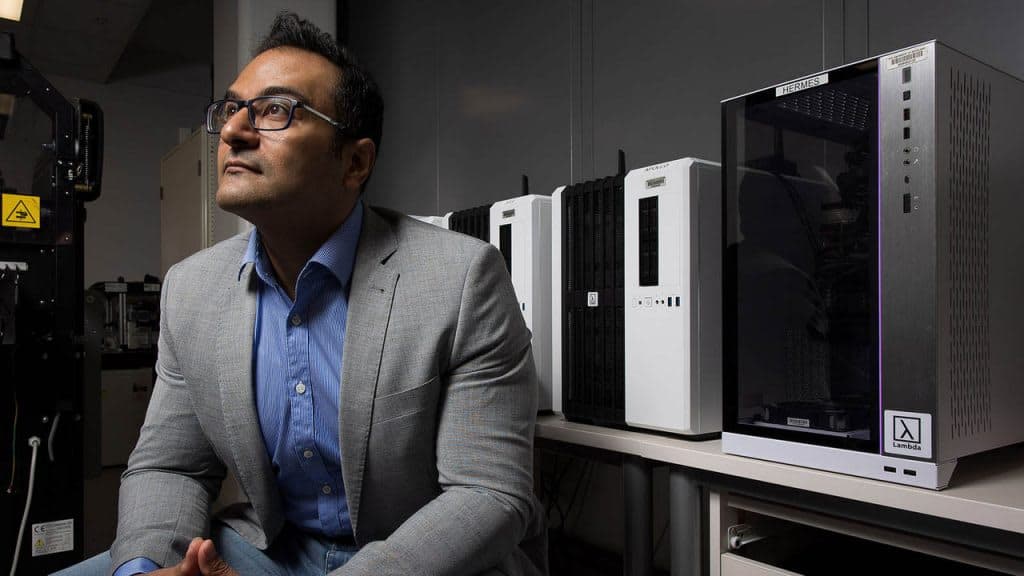
In the Faculty of Engineering, Dr Reza Shahamiri uses his deep learning engineering expertise to design software platforms that leverage AI technologies to make healthcare services more accessible and provide healthcare professionals with better digital tools to help patients and their families.
For more than a decade, Reza has been developing automatic speech-recognition technologies, similar to Apple’s Siri, which can hear and comprehend the otherwise unintelligible speech of those with speech impediments.
“When we enable computers to hear the atypical speech, the impact of this technology is way beyond having software like Siri that can understand them. We can build automated speech therapy systems to help patients find their voice.”
Another project involves the analysis of speech patterns to automatically identify memory flaws and detect the early signs of dementia and memory loss, which prompt an early referral to a specialist.
“With dementia, there is no known cure. The best way to deal with it is to detect it as early as possible so that the progression can be slowed down and managed.”
Designing an AI platform to help with the early identification of autistic children is another of Reza’s long-term projects, and his Autism AI platform has now collected behavioural data from around 12,000 people worldwide.
“It’s very important that we identify autistic children as early as possible to ensure that the effectiveness of support plans is maximised.”
Reinforcing the power of AI, he points to Google’s recent conversational AI diagnostics tool AMIE, which was tested alongside primary care physicians in a blind trial to evaluate patient needs.
“Surprisingly, the AI tool was around 15 percent more accurate in diagnosing patients – and AI asked better questions and communicated more effectively with patients,” says Reza. “Once thoroughly tested and deployed, such technologies could have a huge impact in releasing pressure on our healthcare sector.”
And while open AI research risks being misused, he says that its collaborative nature has fostered the development of powerful tools.
“These AI advancements have significantly boosted our capabilities and opened doors to unimaginable achievements. They are making us smarter and more capable, likely leading to massive productivity improvements.”